 +91-9884504322

Accounts Formula
Learn Accounts with our Focus Point
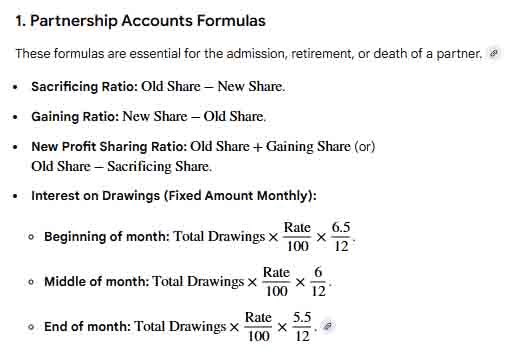
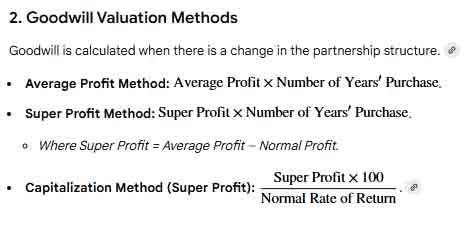
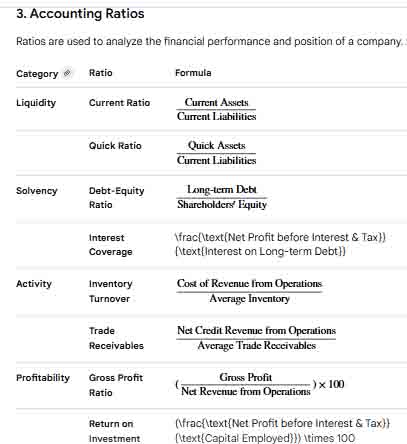
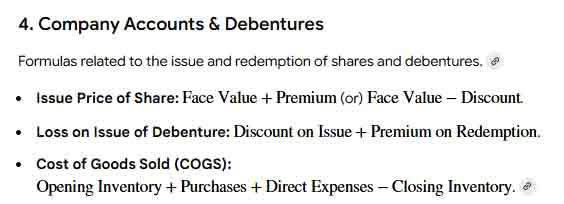
For Class 12 Accountancy, formulas are primarily divided into Partnership Accounts, Company Accounts, and Financial Statement Analysis (Ratios).
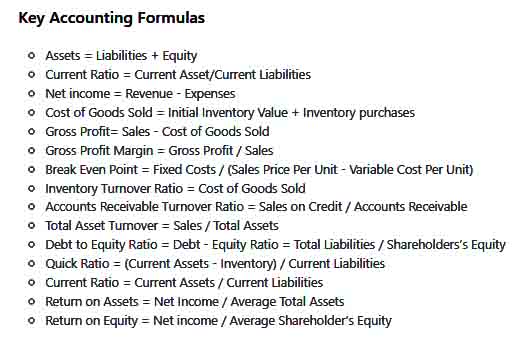
Accounts Receivable Formula
The accounts receivable turnover ratio is one of the financial ratios which helps in measuring whether the company has done effective work in collecting accounts receivable. It reflects how many times, on average, a firm collects its accounts receivable balance during a period of time, usually over one year. Accounts Receivable Turnover Ratio = Net Credit Sales Average - Accounts Receivable
Accounting Rate of Return Formula
Accounting Rate of Return (ARR), or "Return on Investment" (ROI) under accounting, represents the average accounting return from an investment, or is the rate of return on equity. It measures the average annual income of an investment expressed as a percentage of the original investment.
The formula used in calculating the accounting rate of return
ARR = (Average annual profit / investment) * 100.
Profit and Loss (P & L) Formulas
The Profit & Loss (P&L) account shows a company's financial performance over a period by summarizing its revenues, expenses, and resulting profit or loss. Understanding these formulas helps students interpret business profitability, cost structure, and operational efficiency—key concepts in accounting and competitive exams.
Balance Sheet Formula
The balance sheet presents a company's financial position at a specific date. It summarizes what the company owns (assets), what it owes (liabilities), and the residual interest of the owners (equity). The formulas below form the basis of balance sheet preparation and interpretation.